
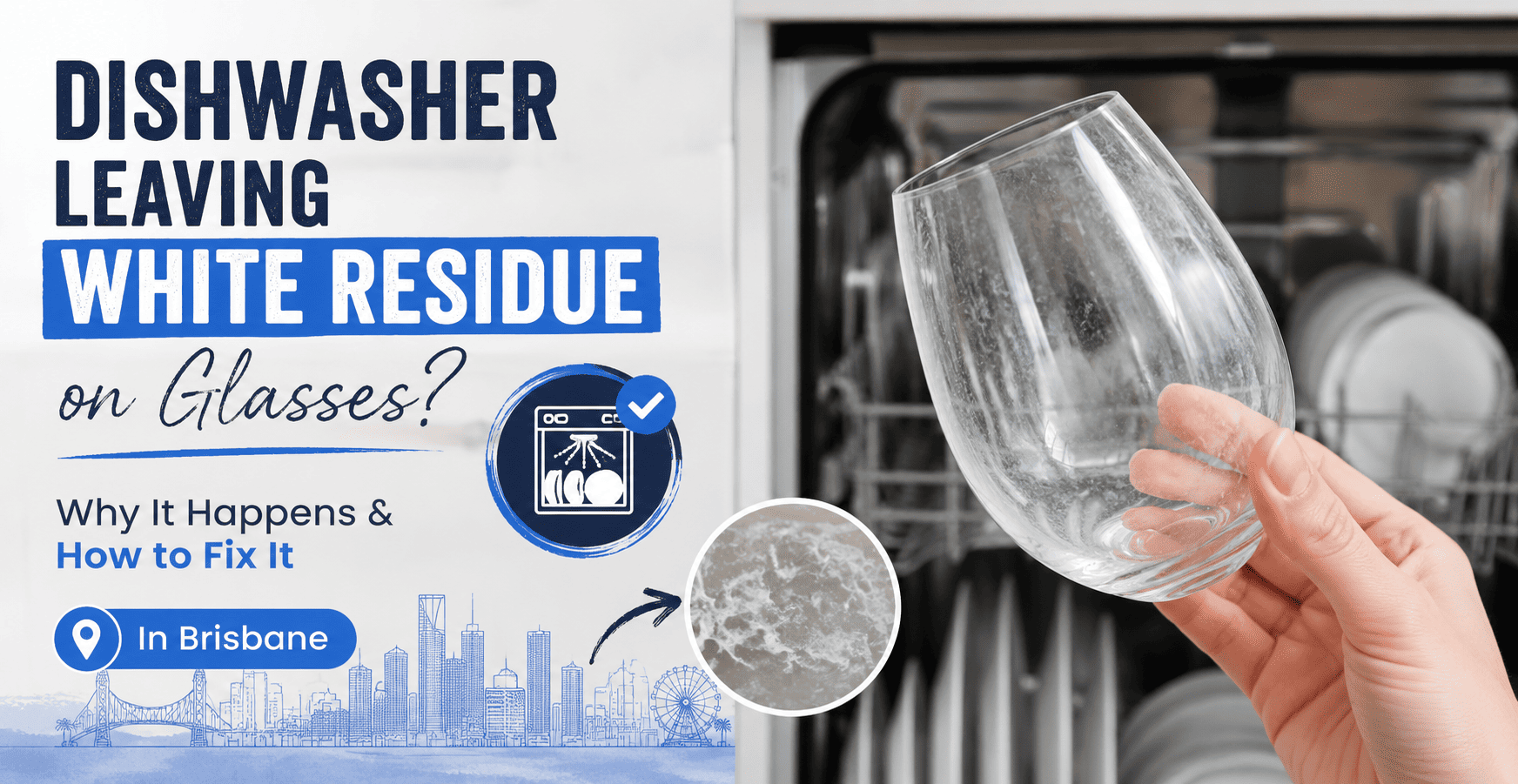
There’s something annoying about pulling glasses out of a dishwasher and holding them up to the light, only to find them covered in a milky white film or chalky residue. You may as well have left them in the sink.
It’s one of the most common complaints we hear on dishwasher repair jobs across Brisbane, and it has a few different causes. Some of them are simple to fix yourself. Others point to a fault in the machine that needs a technician’s attention.
Let’s find out what causes white residue on glasses, how to identify what type of problem you’re dealing with, and what to do about it.
First: What Type of Residue Are You Dealing With?
Not all white residue on glasses is the same, and identifying the type will help you pinpoint the cause.
Chalky, powdery white film that can be easily wiped off with a cloth is usually limescale or mineral buildup, typically caused by hard water.
Cloudy, etched appearance where the glass itself looks permanently hazy and the haziness doesn’t wipe away, is a different issue entirely. This is called glass etching, and it’s permanent damage caused by corrosion of the glass.
White spots or streaks that appear in a specific pattern may indicate a rinse aid problem, a blocked spray arm, or an issue with water temperature.
It’s important to distinguish between these early on because limescale residue is entirely fixable, while glass etching cannot be reversed. The glass is permanently damaged.
Cause 1: Hard Water and Limescale Buildup
This is the most common cause of white residue on glasses in Brisbane and surrounding areas.
Brisbane’s water supply contains dissolved minerals, particularly calcium and magnesium. When this water is heated inside your dishwasher and then dries on your glasses, those minerals are left behind as a white chalky deposit. This is limescale, and it’s exactly the same substance that builds up inside your kettle.
The harder the water supply in your area, the worse this problem will be. Brisbane’s water is considered moderately hard, which means limescale is a genuine issue for many households. It’s one of several ways our local climate and water conditions quietly wear on household appliances over time.
How to test if it’s limescale: soak one of your affected glasses in white vinegar for 15 to 20 minutes, then rub off the residue. If it dissolves or wipes away, it’s limescale. If the haze remains, you’re likely dealing with etching.
Cause 2: Insufficient Rinse Aid
Rinse aid is not optional in Brisbane. It serves a specific function: it lowers the surface tension of water so it sheets off your dishes rather than forming droplets that dry into spots.
Without adequate rinse aid, water dries on your glasses as small droplets, leaving concentrated mineral deposits wherever each droplet lands. The result is exactly the white spotty residue you’re seeing. The same shortfall is often behind dishes still being wet at the end of a cycle, so if you’re seeing both, start here.
Check your rinse aid dispenser and refill it if it’s empty or low. Most dishwashers have an indicator light for this. Also, check the dispenser setting; most machines allow you to adjust how much rinse aid is dispensed per cycle, and in Brisbane’s conditions, a higher setting often produces better results.
Cause 3: Using Too Much Detergent
More detergent does not mean cleaner dishes. Excess detergent that doesn’t fully rinse away can leave a white, soapy film on glasses, especially if your wash temperature is too low to fully dissolve it.
This is especially common when households switch between detergent brands or pod formulas without adjusting the quantity, or when cheaper detergents don’t dissolve as well in cold water.
Try reducing your detergent quantity slightly and running a hot cycle to see if this makes a difference.
Cause 4: The Wrong Water Temperature
Dishwashers need water to be at a sufficient temperature to properly activate the detergent and dissolve grease and residue. Most dishwashers are designed to heat water internally, but they rely on your home’s hot water supply being connected at an adequate temperature.
If the water entering your machine is too cold, the detergent won’t activate properly, the mineral deposits won’t rinse away effectively, and you’ll end up with residue on your glasses.
Check that your hot water system is delivering water at an appropriate temperature and that your dishwasher is connected to the hot water supply, not the cold. Some dishwashers are designed to be connected to cold water and heat it internally; check your manual if you’re unsure. If the machine went in during a renovation or a kitchen fit-out, it’s worth confirming which supply it was plumbed into, because a dishwasher installation done in a hurry is a common reason residue shows up on a brand new machine.
Cause 5: Blocked Spray Arms
Your dishwasher’s spray arms distribute water throughout the machine during each cycle. They have small holes along their length that can become blocked by food particles, limescale, or detergent residue over time.
When spray arm holes are partially blocked, water distribution becomes uneven. Some glasses get properly rinsed and come out clean, while others that sit in a lower-water zone come out spotty and covered in residue. Poor water distribution sits behind a surprising number of dishwasher problems, not just residue on glassware.
Check your spray arms by removing them (most unclip or unscrew easily) and holding them up to the light. If you can see blockages in the holes, clean them out with a toothpick and rinse them under running water before replacing.
Cause 6: The Dishwasher Filter Needs Cleaning
Every dishwasher has a filter at the bottom of the machine that catches food particles and debris. When this filter becomes clogged, dirty water from the wash cycle can recirculate back over your dishes during the rinse phase, leaving residue behind.
Cleaning the filter is a simple job. Twist it out from the bottom of the machine, rinse it under running water, and use a soft brush to remove any stubborn buildup. In Brisbane households that use the dishwasher daily, the filter should be cleaned at least once a month. Pair it with a descaling cycle; our guide to cleaning a dishwasher with white vinegar and bicarb soda walks through the process step by step.
Cause 7: A Faulty Rinse Aid Dispenser
If you’re keeping your rinse aid topped up but still getting white residue, the dispenser itself may be faulty. A cracked or blocked dispenser that isn’t releasing rinse aid at the right point in the cycle will produce exactly the same result as having no rinse aid at all.
You can test this by manually adding a small amount of rinse aid directly to the bottom of the dishwasher before a cycle and seeing if the results improve. If they do, the dispenser likely needs attention. It’s a repair we carry out regularly on European machines, and it’s one of the more frequent faults we see during Bosch dishwasher repairs once a machine passes the five-year mark.
The Permanent Problem: Glass Etching
If you’ve tried the vinegar test and the haze on your glasses doesn’t respond, the glass has likely been etched. This is irreversible.
Glass etching in dishwashers is caused by a combination of overly hot water, excessive or aggressive detergent, and soft water conditions (where the water is low in minerals, the dishwasher detergent can become too aggressive on the glass itself).
It’s more common with delicate glassware, crystal, and older or thinner glasses. Modern dishwashers with energy-saving modes and high-performance detergents can sometimes produce etching more quickly than older machines did.
Prevention involves using a gentle detergent, avoiding excessively hot wash cycles for glassware, and using a proper rinse aid. Etched glasses, unfortunately, cannot be salvaged.
A Practical Fix Checklist for Brisbane Homeowners
Work through this in order before calling a technician:
- Top up your rinse aid dispenser and increase the dispenser setting
- Check and clean the spray arms for blockages
- Clean the dishwasher filter thoroughly
- Run a hot cleaning cycle with a dishwasher cleaner or white vinegar
- Check your detergent quantity and switch to a quality brand if using a budget option
- Soak an affected glass in vinegar to confirm whether it’s limescale or etching
- Check that your machine is connected to a hot water supply at the correct temperature
Households that run a dishwasher daily often fold these jobs into a scheduled appliance maintenance plan so the filter and spray arms never get far enough gone to cause problems.
If you’ve worked through this list and the problem persists, it’s time to call in a professional.
When to Call a Dishwasher Technician in Brisbane
Some white residue problems point to mechanical or electrical faults that require a qualified repairer:
- The heating element isn’t reaching the correct temperature (your machine may run through cycles without properly heating the water)
- The rinse aid dispenser is cracked or faulty and needs replacement
- The water inlet valve is partially blocked and restricting water flow
- The pump or spray arm system isn’t circulating water correctly
- The machine is showing error codes alongside the residue problem
These aren’t issues that cleaning and detergent adjustments will fix. An experienced technician can diagnose them quickly, usually in a single visit, and get your dishwasher performing properly again. If the same machine is well past ten years old and stacking up other faults alongside the residue, it’s worth weighing up whether repairing or replacing it makes better financial sense before you spend anything.
Still Getting Cloudy Glasses After Trying Everything?
If you’ve worked through all the DIY fixes and your dishwasher is still leaving white residue on your glasses, there’s likely a mechanical issue that needs attention from a qualified technician.
At Ideal Refrigeration & Appliance Services, we repair all major dishwashers across Brisbane and the surrounding suburbs, including Bosch, Miele, Fisher & Paykel, and more. We arrive on time, diagnose the problem clearly, and give you a straight, upfront quote before any work begins.
Call on 0428 149 923 or book your service online. Same-day repairs are available, and after-hours bookings can be arranged for when life doesn’t wait for business hours.
FAQs: White Residue on Glasses in Brisbane
How do I know if my Brisbane suburb has hard water?
Brisbane’s water supply comes from several catchments and varies slightly by area, but is generally considered moderately hard. If you notice limescale buildup in your kettle or on your taps, your water hardness is contributing to your dishwasher residue problem.
Can I use dishwasher salt to reduce limescale?
Yes, if your dishwasher has a salt compartment (common on European brands like Bosch, Miele, and ASKO), filling it with dedicated dishwasher salt helps soften the water inside the machine and significantly reduces limescale deposits on glasses. Our Miele dishwasher maintenance guide covers how often to top the salt up and what else these machines need.
My dishwasher is relatively new and already leaving residue. Is it faulty?
Not necessarily, new machines often need a few adjustments to the rinse aid level and detergent quantity to work well in your home’s specific water conditions. Try increasing the rinse aid dosage first. If the problem persists after adjustment, have a technician take a look.
Is white vinegar safe to use in my dishwasher for cleaning?
Yes. Place a cup of white vinegar in a dishwasher-safe container on the top rack and run a hot cycle. It’s an effective and inexpensive way to break down limescale and mineral buildup inside the machine. Don’t mix it with detergent in the same cycle.
Could my glasses just be old and the coating is wearing off?
Yes, this is possible. Many glasses have a protective coating that can wear off over many dishwasher cycles, making them more likely to appear cloudy. This is different from limescale deposits and from etching caused by detergent.
What’s the best rinse aid for Brisbane water conditions?
Any quality brand-name rinse aid will help significantly. Finish, Somat, and the branded rinse aids for Bosch and Miele are all reliable choices. The key is to keep the dispenser full and set it to a slightly higher dose for Brisbane’s water conditions.